
Guide · Costs · Updated October 18, 2026
What a Roof Replacement Costs in Cincinnati (2026)
Installed prices for a new roof across Greater Cincinnati in 2026, what moves a quote up or down, when the city or county wants a permit, and what Ohio does — and does not — require of the roofer.
What a Roof Replacement Costs in Cincinnati (2026)
Three quotes, one roof, three different jobs
Ask three roofers to price the same Cincinnati house and the numbers can come back thousands of dollars apart. That is rarely one company gouging. Each roofer has quietly made decisions the others may not have: how many layers come off, how much rotten decking to allow for, whether the flashing is new or bent back into place, whether ice-and-water membrane goes in the valleys, and how many years they will stand behind their own labor.
This guide sets out what a roof replacement costs in Cincinnati and the surrounding suburbs in 2026, what pushes a price up or down, what the city or county asks of the job, and how to read a written quote so that three of them can be compared. The figures are ranges, not quotes. The only real number is a written, itemized proposal from a roofer who has been up on your roof.
What a roof replacement costs in Cincinnati in 2026
Roofers price by the square: 100 square feet of roof surface, which is not the same thing as the floor area of the house. For architectural asphalt shingles — the thicker, dimensional kind on most houses in the region — with one layer torn off and a pitch a crew can walk, most Greater Cincinnati quotes land between roughly $450 and $700 per square, installed. That covers tear-off and disposal, underlayment, flashing, vents and labor. Replacing rotten decking is extra, and is priced separately.
| Roof size | Typical house | Installed, architectural shingles |
|---|---|---|
| 12–16 squares | Cape Cod, bungalow or small two-story | $5,500–$11,000 |
| 18–24 squares | Three-bedroom ranch, or a two-story of 2,000–3,000 sq ft | $8,000–$17,000 |
| 25–32 squares | Larger ranch, or a two-story with an attached garage | $11,000–$22,500 |
| 35+ squares | Large, steep or heavily cut-up roofs | $16,000 and up |
These are working ranges assembled from the prices roofers serving Southwest Ohio published for 2025 and 2026, checked against national estimating guides, and the same per-square arithmetic holds from Anderson Township to Kettering. A roof’s square count usually runs higher than people expect: overhangs and pitch add area, and roofers add 10 to 15 percent for waste on the cuts. A two-story house has roughly half the roof of a ranch with the same floor space.
The short version
- Budget about $450–$700 per square for architectural shingles with one layer torn off, plus an allowance for decking.
- Have every quote state its square count, so three quotes can be compared line for line.
- Inside the City of Cincinnati, re-roofing a one-, two- or three-family house generally needs no permit. In unincorporated Hamilton County it goes through a county permit.
- Ohio does not license roofers. Check their insurance yourself, including workers’ compensation with the Ohio BWC.
- Signed a contract at your front door? Ohio law lets you cancel it until midnight of the third business day.
How a roofer gets from your house to a number
Five things decide where in that range a quote falls.
- Measured area. Many roofers now measure from aerial or drone imagery rather than with a tape on the roof. Either way, ask for the square count in writing — it is the one figure every quote should share.
- Pitch. Up to about a 6-in-12 slope, a crew can walk the roof. Steeper roofs — common on the city’s Victorians, Tudors and Cape Cods — need harnesses, roof jacks and more hours, and the per-square price climbs with them.
- Complexity. Every valley, dormer, chimney, skylight and wall the roof runs into is flashing work done by hand. A plain gable ranch is the cheapest roof per square there is; a cut-up roof on a Clifton or Hyde Park house can cost far more per square for the same shingle.
- Layers. Each layer of old shingles that comes off is more labor and more tonnage in the dumpster.
- Access. A hillside lot, a narrow street or no driveway means materials carried farther by hand. Inside the city, a dumpster parked in the street needs a right-of-way permit from the Department of Transportation and Engineering even when the roof itself needs none — ask whether that is in the price.
What your house’s age does to the price
Greater Cincinnati’s housing splits sharply by county, and the split shows up in roofing quotes. The median owner-occupied home in Hamilton County was built in 1961, and in Montgomery County, around Dayton, in 1966. In Butler County it was 1983, and in Warren County 1998, according to the Census Bureau’s 2024 American Community Survey.
In the older half — Cincinnati, the inner suburbs, Dayton and Kettering — the surprises are under the shingles. Houses built before plywood was standard often have board decking: planks rather than sheets. Ohio’s residential code requires asphalt shingles to be fastened to a solidly sheathed deck, so gapped boards — sometimes left over from an original wood-shingle roof — have to be covered with new sheathing, and across a whole roof that is a project of its own. Older roofs are also likelier to be carrying a second layer, and masonry chimneys usually need new step flashing and counterflashing rather than the old metal bent back into place.

Ask for decking as a per-sheet price in the quote — typically somewhere around $75 to $150 for a 4-by-8 sheet, installed — and ask the crew to photograph the bad boards before they replace them. For scale, a 20-square roof is about 63 sheets, so a full re-deck at those prices adds roughly $4,700 to $9,500 to the job.
Slate is a different conversation. Plenty of Victorian-era houses in Cincinnati still wear their original slate, and Ohio’s code does not allow new shingles to be laid over it. Sound slate can often be repaired — broken pieces swapped, flashing renewed — for far less than replacement costs. Before agreeing to tear a slate roof off, get an opinion from a roofer who repairs slate rather than only replacing it.
In the newer half — West Chester, Liberty Township, Mason, Lebanon and Springboro — the decking is sheet goods and the surprises are fewer. What these houses share is timing: subdivisions built through the late 1990s and 2000s are reaching the end of their original builder-grade shingles together, which is why some streets seem to re-roof all at once. Two things to settle before signing: whether your homeowners’ association has to approve the shingle color, and whether the attic ventilation is being brought up to the shingle maker’s requirements, since manufacturers tie their warranties to it.
Tear-off or a second layer?
Laying new shingles over old ones saves the cost of tear-off and disposal, and Ohio’s code allows it — but rules it out on many of the roofs that would want it. A new layer is not permitted where the roof already has two or more layers, where the existing roof is water-soaked or deteriorated, or where it is slate, clay or cement tile. Inside the City of Cincinnati, the permit exemption for re-roofing also stops at two layers of roofing material.
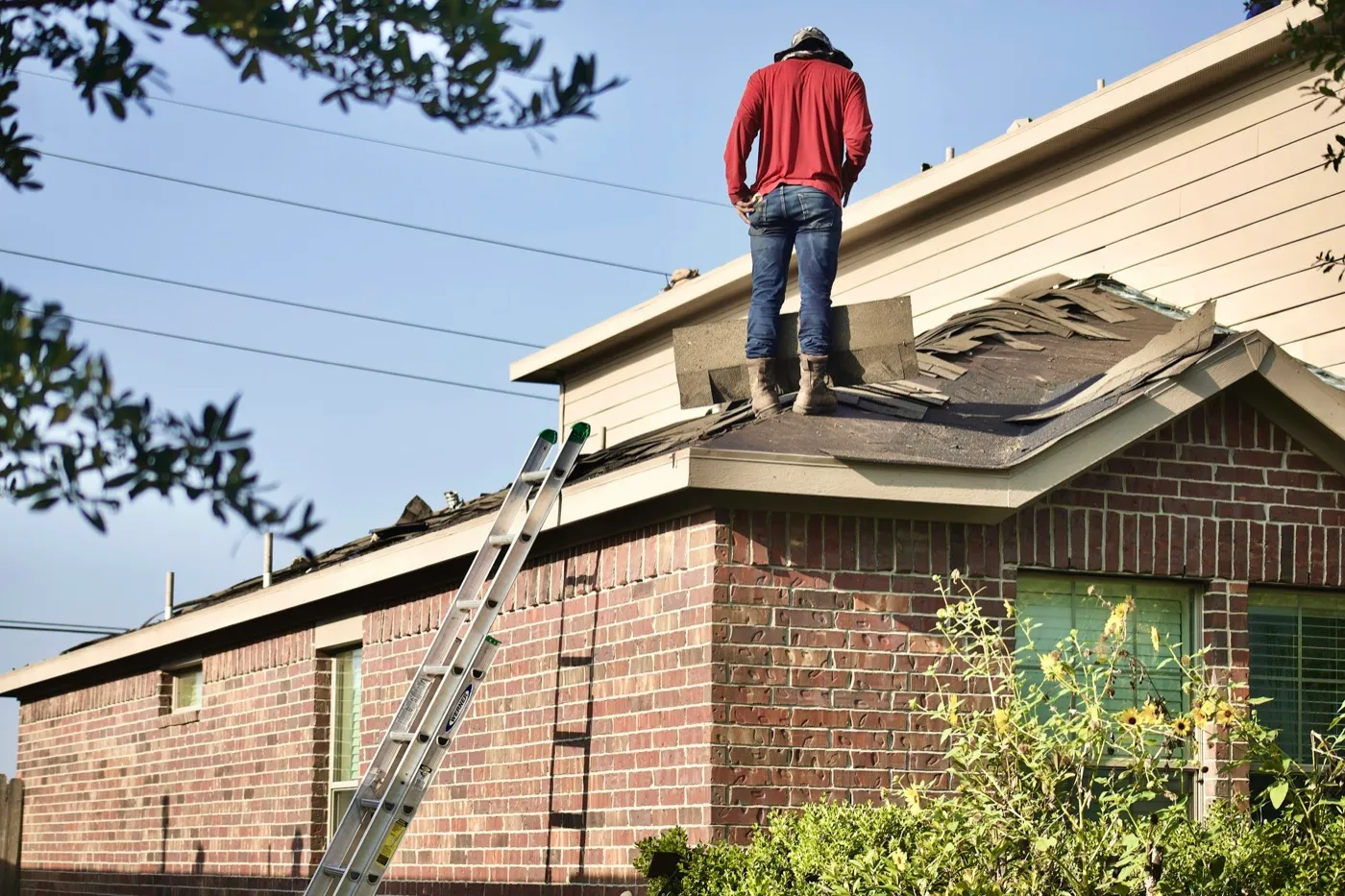
Even where a layover is allowed, it buries the deck where nobody can inspect it, adds weight, and uses up the house’s last allowable layer, so the next roof becomes a two-layer tear-off. On most older houses here, a full tear-off is the better buy.
Asphalt, metal or slate
Architectural asphalt is the default for good reasons: it is the cheapest per square, every roofer installs it, and it suits nearly every house style in the region. Standing-seam metal runs roughly $850 to $1,500 per square — two to three times asphalt — in exchange for a much longer service life. Natural slate is specialist work at around $1,500 to $3,000 per square, which is why repairing an existing slate roof so often wins the arithmetic.
What a written roofing quote should spell out
A good quote lets you see what the roofer decided. Before comparing prices, check that each one states:
- The square count and the exact shingle — maker and product line, not just “architectural.”
- How many layers come off, and that tear-off and disposal are included.
- Underlayment and ice barrier — what goes under the shingles, and whether self-adhering ice-and-water membrane runs along the eaves and in the valleys.
- Flashing — new drip edge, new step flashing where the roof meets a wall, new chimney counterflashing — or exactly which pieces are being reused.
- Ventilation — ridge vent, intake vents and new pipe boots.
- Decking — the price per sheet, and how damaged boards will be shown to you before they are replaced.
- Site protection and cleanup — the dumpster, tarps over planting beds and the air-conditioning unit, and a magnetic sweep for nails.
- The permit — whether one is needed at your address, and who is pulling it.
- Warranty — how many years on the roofer’s own workmanship, and whether they will register the manufacturer’s warranty for you.
- Payment — the deposit, and when the balance is due. Never pay in full before the work is done.
If two quotes differ by thousands, lay them side by side against this list. The gap is almost always a line one roofer included and the other left out.
Do you need a permit to replace a roof in Cincinnati?
It depends on which building department covers your address, and the answer genuinely differs across the metro.
Inside the City of Cincinnati, the city’s own permit guide lists roof coverings on one-, two- and three-family detached houses among the work that generally does not need a permit, as long as there are no more than two layers of roofing material. Gutters, downspouts and siding are on the same list. The exception is a locally designated historic property: there you need a Certificate of Appropriateness from the city’s Urban Conservator before work starts.
In the unincorporated townships of Hamilton County — Anderson, Colerain, Delhi, Green, Springfield, Symmes and the rest — building permits come from the county’s Buildings + Inspections division, and re-roofing goes through a permit application with the county’s Roofing Data Sheet: the existing covering, the decking type, the pitch, the number of existing layers and the product going on. The same sheet requires an ice barrier from the eaves to at least 24 inches inside the exterior wall.
Everywhere else, ask. Ohio’s residential code lists the small jobs that are exempt from approval statewide — sheds of 200 square feet or less, fences up to six feet, painting — and re-roofing is not among them, so do not assume your city follows Cincinnati’s rule. A roofer who works your area regularly will tell you in one sentence which department issues the permit. If the answer is vague, call the department yourself.
Ohio doesn’t license roofers. Check these instead.
Ohio’s Construction Industry Licensing Board licenses five specialty trades — electrical, HVAC, plumbing, hydronics and refrigeration — and it regulates them for commercial work; residential contractors are regulated by local building departments. There is no state roofing license, so “licensed and insured” on the side of a roofer’s truck cannot mean a state roofing license. Some cities register contractors locally, and your building department can tell you whether yours does.
What you can check yourself, in about ten minutes:
- Workers’ compensation. Ohio is one of four states where employers buy workers’ compensation from the state rather than from private insurers, so coverage is a matter of public record: the Ohio Bureau of Workers’ Compensation’s employer look-up shows whether a business has an active policy. Roofing is dangerous work, and an injured worker with no coverage behind them is exactly the situation this check rules out.
- Liability insurance. Ask for a certificate of general liability insurance sent to you by the roofer’s insurance agent, not a PDF forwarded by the roofer.
- A local address and a track record. A company with a street address in the region, a phone a person answers and a long run of reviews has something to lose. Read the three-star reviews first; they tend to be written by customers with a specific complaint and no axe to grind.
- A written contract that covers the quote checklist above, signed before materials are ordered.
A bill in the Ohio House, House Bill 769, would add roofing-specific rules: written contracts, a three-day cancellation period, limits on deposits, and a ban on advertising deductible waivers. As of October 2026 it is still in committee, so none of it is law yet.
Storm damage, insurance and the knock on the door
Spring and early-summer storms bring hail and wind to Southwest Ohio, and they bring door-knockers with them: crews that turn up uninvited the day after a storm, offer a free inspection, and want a signature on the spot. Some are legitimate. The ones that are not tend to follow the same script, and Ohio law gives you room to step back from it.
- You can cancel a contract signed at home. Under Ohio’s Home Solicitation Sales Act, a sale of $25 or more made in person at your home can be cancelled until midnight of the third business day after you sign. The seller has to give you a written cancellation form, cannot start work during those three days, and must refund you within ten days of your cancellation.
- Read the inspection paperwork. A form you sign so a roofer can “meet your adjuster” may be a contract that commits you to that roofer if the claim is approved. Treat anything with a signature line as a contract.
- Be wary of any offer to cover your deductible. If a roofer says they will “take care of” it, ask how. An estimate inflated so the insurer pays your share is a false statement in support of a claim, which Ohio’s insurance-fraud statute prohibits — and the claim is in your name.
- Call your insurer or agent first, photograph the damage, and check your declarations page for a separate wind or hail deductible. Some policies set it as a percentage of the home’s insured value rather than a flat amount, which can make it far larger than people expect.
When to book
Storm season fills roofers’ calendars from spring into summer, with storm-damage jobs stacking up behind each other. If your roof is simply old rather than damaged, late summer and fall are usually the easier time to collect quotes and get a start date. Shingles can go on in winter, but their sealant strips need warmth to bond, so cold-weather installs call for the manufacturer’s extra steps — ask how the roofer handles them.
Find a roofer, and line up the rest
When you are ready for quotes, the roofing contractors list ranks real, local roofing companies across Greater Cincinnati and Dayton by Google star rating, each with its own phone number, and every city page narrows it to the roofers who serve that area. A new roof is also a good moment to deal with what sits around it: gutter companies often schedule alongside a re-roof, and a tree service can take down limbs hanging over the roof before the crew arrives.
Common questions
How much does a roof replacement cost in Cincinnati in 2026?
For architectural asphalt shingles with one layer torn off, most quotes in Greater Cincinnati fall between about $450 and $700 per square — 100 square feet of roof surface. That puts a Cape Cod or bungalow at roughly $5,500 to $11,000, a three-bedroom ranch or a typical two-story at $8,000 to $17,000, and larger or steeper roofs higher. Replacing rotten decking is extra and is usually priced per sheet.
Do I need a permit to replace my roof in Cincinnati?
Inside the City of Cincinnati, the city’s permit guide lists roof coverings on one-, two- and three-family detached houses among the work that generally needs no permit, as long as there are no more than two layers of roofing material; a locally designated historic property needs a Certificate of Appropriateness first. In the unincorporated townships, Hamilton County Buildings + Inspections handles re-roofing through a permit application. Anywhere else, ask the building department that covers your address.
Does Ohio require roofing contractors to be licensed?
No. The Ohio Construction Industry Licensing Board licenses five commercial trades — electrical, HVAC, plumbing, hydronics and refrigeration — and roofing is not one of them. Residential contractors are regulated by local building departments, so ask yours whether it registers roofers. Either way, look up the roofer’s workers’ compensation policy with the Ohio Bureau of Workers’ Compensation and get a liability certificate from their insurance agent.
Can new shingles go over my old roof?
Sometimes, but less often than people expect. The Residential Code of Ohio does not allow a new layer over a roof that already has two or more layers, over slate or tile, or over a roof that is water-soaked or deteriorated. Even where a second layer is allowed, it hides the decking and uses up the house’s last allowable layer, so a full tear-off is usually the better buy on an older house.
Can a roofer pay or waive my insurance deductible in Ohio?
Be wary of any offer to. Ohio has no roofing-specific ban yet — House Bill 769, which would bar roofers from advertising deductible waivers, was still in committee in October 2026. But an estimate inflated so that the insurer ends up covering your deductible is a false statement in support of a claim, which Ohio’s insurance-fraud statute prohibits, and the claim is filed in your name.
Sources
The official pages behind the rules quoted above — all free to read. Prices are ranges, not quotes; the only real number is a written proposal for your own roof.
- City of Cincinnati Buildings & Inspections — Do I need a permit?
- City of Cincinnati Department of Transportation & Engineering — Permits and licenses
- Hamilton County Buildings + Inspections — Residential permit guides (Roofing Data Sheet)
- Residential Code of Ohio — Roof assemblies, OAC 4101:8-9-01
- Residential Code of Ohio — Administration, OAC 4101:8-1-01
- Ohio Construction Industry Licensing Board
- Ohio Bureau of Workers’ Compensation — Employer look-up
- Ohio Attorney General — Door-to-door sales
- Ohio Revised Code 1345.23 — Home solicitation sales
- Ohio Revised Code 2913.47 — Insurance fraud
- Ohio House — House Bill 769, 136th General Assembly
- U.S. Census Bureau, American Community Survey — median year built, table B25037